Henoch-Schonlein purpura
In Henoch-Schonlein purpura, some of the body’s small blood vessels become inflamed, which can cause bleeding in the skin, joints, abdomen and kidneys. HSP –> intussusception! (due to bowel wall bleed and thickening) - usually jejunal (as opposed to ileocecal) - usually long segments
Henoch-Schonlein purpura
Henoch-Schonlein purpura (HEN-awk SHURN-line PUR-pu-ruh)
Cholecystomy tube - you have to make sure cystic duct is patent – contrast HAS to transit all the way to the small bowel!!!
Cholecystomy tube - you have to make sure cystic duct is patent – contrast HAS to transit all the way to the small bowel!!!
After resolution of clinical symptoms and decreased output from the catheter (less than 10 cc per day), abscessogram should be performed to evaluate for residual collection prior to removal.
After resolution of clinical symptoms and decreased output from the catheter (less than 10 cc per day), abscessogram should be performed to evaluate for residual collection prior to removal.
Facial colliculus syndrome
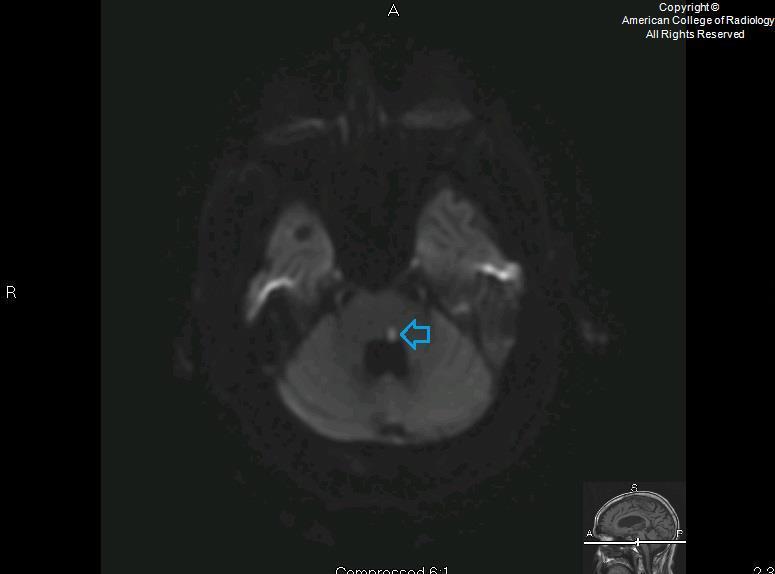
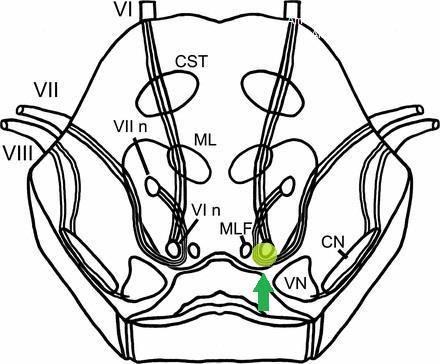
- Facial colliculus syndrome refers to a combination of neurological signs including facial palsy and lateral gaze palsy, secondary to a lesion in the facial colliculus involving motor fibers of the facial nerve and the (adjacent) nucleus of the abducens nerve. In some cases, the adjacent fibers of the MLF are also involved, which produces a conjugate gaze palsy.
- The nucleus of the abducens nerve nucleus is located in the facial colliculus on the floor of the fourth ventricle in the mid to lower portion of the pons. Fibers of the facial nerve loop around the abducens nerve in the facial colliculus.
- The MLF is the white matter tract that is located in the posterior pons near the midline, just anterior to the fourth ventricle. It contains neural fibers that interconnect the oculomotor, trochlear, abducens, and the vestibular nuclei, and it coordinates the actions of the oculomotor and abducens nuclei.
Hemangioendotheliomas tend to
spontaneously involute without therapy over a
course of months to years. Sequential ultrasounds
are often used to follow lesions and
most often demonstrate a progressive decrease
in size and an increase in degree of calcification.
Hemangioendotheliomas tend to
spontaneously involute without therapy over a
course of months to years.
Sequential ultrasounds
are often used to follow lesions and
most often demonstrate a progressive decrease
in size and an increase in degree of calcification.
the dark signal within the spleen (S), which is normal in
neonates. The spleen does not take on the typical high T2-
signal appearance until after the white pulp develops at several
weeks of age.
the dark signal within the spleen (S), which is normal in
neonates. The spleen does not take on the typical high T2-
signal appearance until after the white pulp develops at several
weeks of age.
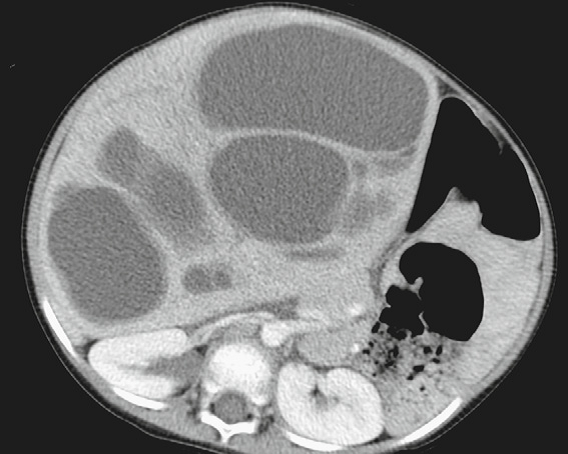
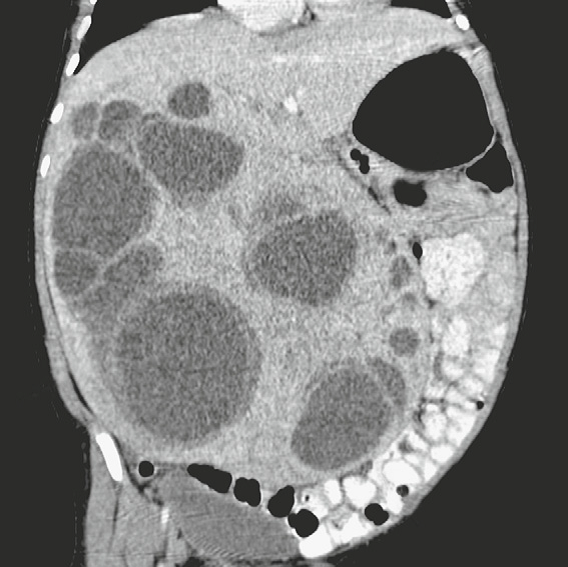
Mesenchymal Hamartoma of the Liver
Large, multilocular, cystic masses with thin internal septations
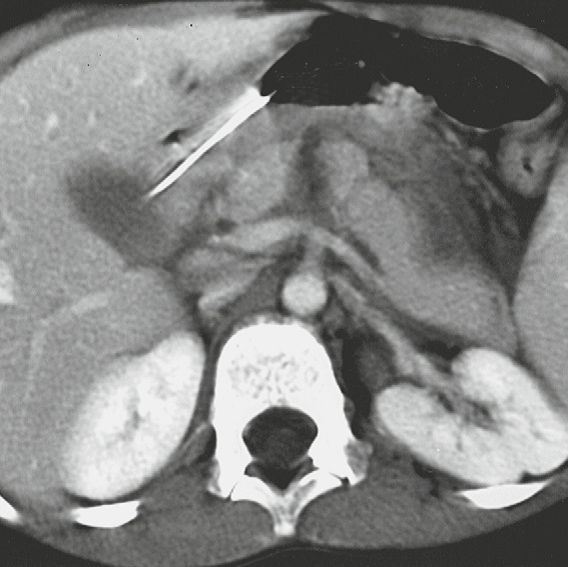
Traumatic pancreatic transection
Fluid (arrowhead) between the pancreas and splenic vein,
a sensitive finding of pancreatic injury.
Pseudomembranous colitis
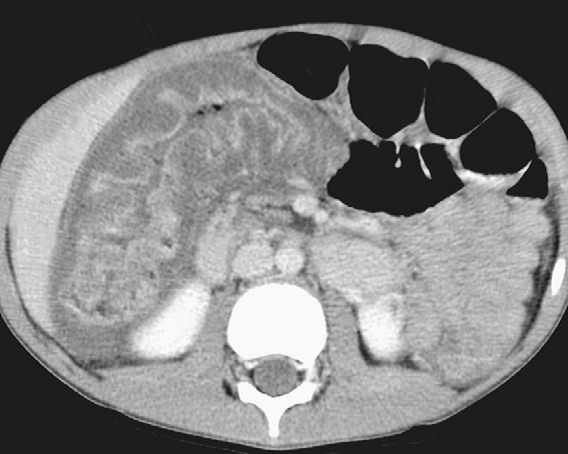
- contrast material to insinuate between the pseudomembranes and swollen haustra – accordion sign
- Because pseudomembranous colitis involves predominantly
the mucosa and submucosa, the degree of inflammatory change in the pericolonic fat is often disproportionately subtle compared to the degree of colonic wall thickening
Acute GVHD of bowel
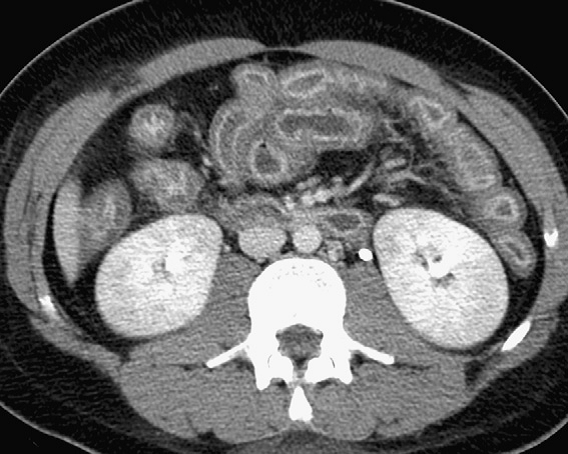
- donor T lymphocytes cause selected epithelial damage of recipient target organs. Histopathologically, there is extensive crypt cell necrosis and, in severe cases, diffuse destruction of the mucosa throughout both the large and
small bowel and replacement with a thin layer
of highly vascular granulation tissue. - bowel wall thickening may be mild, isolated to
the small bowel, or absent. - More characteristically, there is abnormal bowel wall enhancement in a central, mucosal location corresponding pathologically with the thin layer of vascular granulation tissue replacing the destroyed
mucosa
Immunosuppression related Lymphoproliferative disorders are lymphomalike diseases related to an uncontrolled proliferation
of cells infected by the Ebstein-Barr virus in an immunocompromised host.
PTLD - EBV-related
- spectrum of imaging findings:
- focal parenchymal mass
- diffuse LAD
- mesenteric mass
- bowel wall thickening with associated aneurysmal dilatation of small bowel lumen
- In contrast to typical non-Hodgkin lymphoma (more commonly manifests as abdominal LAD), PTLD more often associated with parenchymal organ involvement
- In solid organ transplant recipients, the distribution of disease tends to occur in the vicinity of the transplant organ.
In older cystic fibrosis patients
“distal intestinal obstruction syndrome”
“meconium ileus” equivalent
In older cystic fibrosis patients
“distal intestinal obstruction syndrome”
“meconium ileus” equivalent
When to image children following UTI?
When to image children following UTI?
- girls - after 2 UTIs
- boys - after 1 UTI
Goal of imaging children after UTI?
- identify underlying congenital anomalies
- identify vesicoureteric reflux
- identify and document renal damage
- establish baseline renal size for subsequent evaluation of renal growth
- establish prognostic factors
Imaging studies for a child with UTI?
- renal U/S
- voiding cystourethrogram - VCUG
The left and right kidneys
should normally be within 1 cm of each other.
If there is a discrepancy of more than 1 cm, an
underlying abnormality should be suspected.
The left and right kidneys should normally be within 1 cm of each other. If there is a discrepancy of more than 1 cm, an underlying abnormality should be suspected.
Techniques for voiding cystourethrogram (VCUG)
- 8F catheter.
- A precontrast scout view of the abdomen is usually
obtained to evaluate for calcifications, to document the bowel pattern so that it is not later mistaken for vesicoureteral reflux, and to document the catheter position within the bladder. - Contrast is then instilled into the bladder.
- An early filling view of the bladder should be obtained to exclude a ureterocele. A ureterocele appears as a round, well-defined filling defect on early filling views. On later full views of the bladder, a ureterocele can be compressed and obscured.
- Once the patient’s bladder is full, bilateral oblique views are obtained to visualize the regions of the ureteral vesicular junctions. These views are typically obtained with the collimators open from top to bottom, with the bladder positioned at the inferior aspect of the screen and the expected path of the ureter included on the film.
- During voiding, the male urethra is optimally imaged with the patient in the oblique projection. The female urethra is
best seen on the anteroposterior view. It is critical to obtain an image of the urethra during voiding, particularly in males. In order to ensure that a view of the urethra is obtained, an image should be obtained during urination
with the catheter in place and then a second view can be obtained after the catheter has been removed. - After the patient has completed voiding, images are obtained of the pelvis and over the kidneys, documenting the presence or absence of vesicoureteral reflux and evaluating the extent of postvoid residual contrast within
the bladder.
Classic testicular microlithiasis is defined as five or more echogenic foci per view in either or both testes,
and
limited testicular microlithiasis defined as one or more echogenic foci that do not satisfy the criteria for classic testicular microlithiasis.
Classic testicular microlithiasis is defined as five or more echogenic foci per view in either or both testes,
and
limited testicular microlithiasis defined as one or more echogenic foci that do not satisfy the criteria for classic testicular microlithiasis.
External anal sphincter - leavator ani muscle
Internal anal sphincter - circular muscle of the anal canal
External anal sphincter - leavator ani muscle
Internal anal sphincter - circular muscle of the anal canal
GI lipoma/lipomatosis
- Most common site is the colon (65–75%) followed by small bowel (20–25%), stomach (5%) and, rarely, esophagus (1–2%).
- Lipomas are the second most common benign lesion in the colon but are far less common than adenomatous polyps. Additionally, lipomas are the most common benign lesion in the small bowel.
- As lipomas are typically incidental findings, no treatment is required unless the patient is symptomatic. Lipomas may be resected endoscopically or surgically depending on location and symptoms. If the mass is larger than 2 cm, it may be symptomatic, causing abdominal pain, intussusception, or anemia due to gastrointestinal bleeding from ulceration.
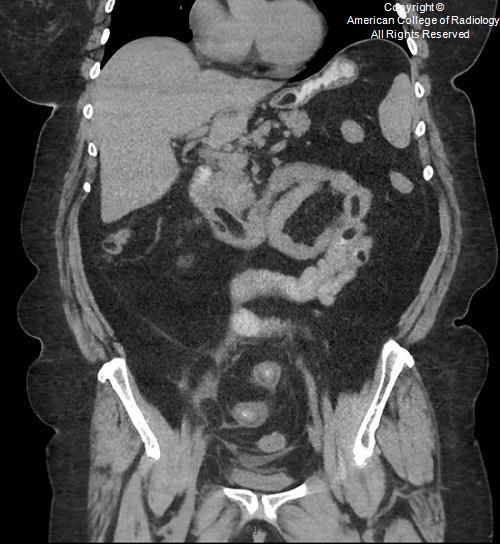
GI lipoma/lipomatosis
- Most common site is the colon (65–75%) followed by small bowel (20–25%), stomach (5%) and, rarely, esophagus (1–2%).
- Lipomas are the second most common benign lesion in the colon but are far less common than adenomatous polyps. Additionally, lipomas are the most common benign lesion in the small bowel.
- As lipomas are typically incidental findings, no treatment is required unless the patient is symptomatic. Lipomas may be resected endoscopically or surgically depending on location and symptoms. If the mass is larger than 2 cm, it may be symptomatic, causing abdominal pain, intussusception, or anemia due to gastrointestinal bleeding from ulceration.
Peritoneal inclusion cyst
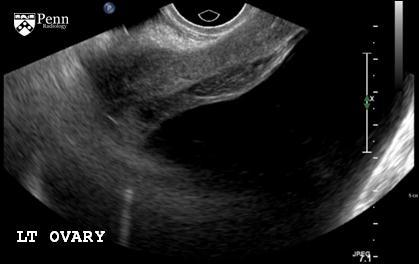
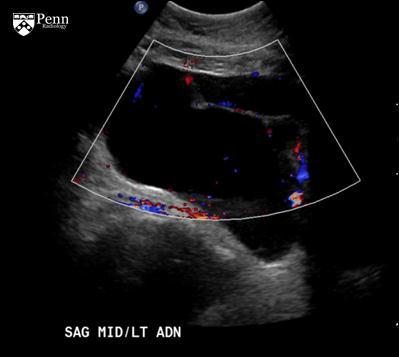
Peritoneal inclusion cyst
Imaging features
- Typically ovoid in shape, but can become irregularly shaped when they are large, conforming to the shape of the pelvis.
- Range in size from a couple millimeters to greater than 10 cm.
- Peritoneal inclusion cysts will always be associated with an ovary.
Ovary may lie in center of cyst, suspended by thin adhesions, like a spider in a web.
Ovary may be eccentrically located within the cyst, adherent to the cyst wall.
Ovary may lie within the cyst wall.
Adjacent ovary will be normal in appearance, though may be slightly distorted due to mass effect.
- Cysts may feature septations and contain complex fluid.
No enhancing components will be identified on contrast-enhanced CT or MRI; the adjacent normal ovary should not be confused with a mural nodule.
Low-resistance flow may be detected in septations on Doppler flow ultrasonography due to small vessels traversing the mesothelial tissue in the cyst walls.
DDx
- Paraovarian cysts - usually separate from the ovary;
- the ovary lies within the lumen or within the wall of a peritoneal inclusion cyst.
- Cystic ovarian cancer is complex with enhancing solid components and no identifiable ovary; peritoneal inclusion cysts are without enhancing components and are adjacent to normal ovaries.
- Loculated ascites develops in the most dependent portions of the pelvis and is associated with peritoneal enhancement; peritoneal inclusion cysts develop adjacent to ovaries and lack enhancement.
- Hydrosalpinx is folded and tubular in shape; peritoneal inclusion cysts are typically ovoid.
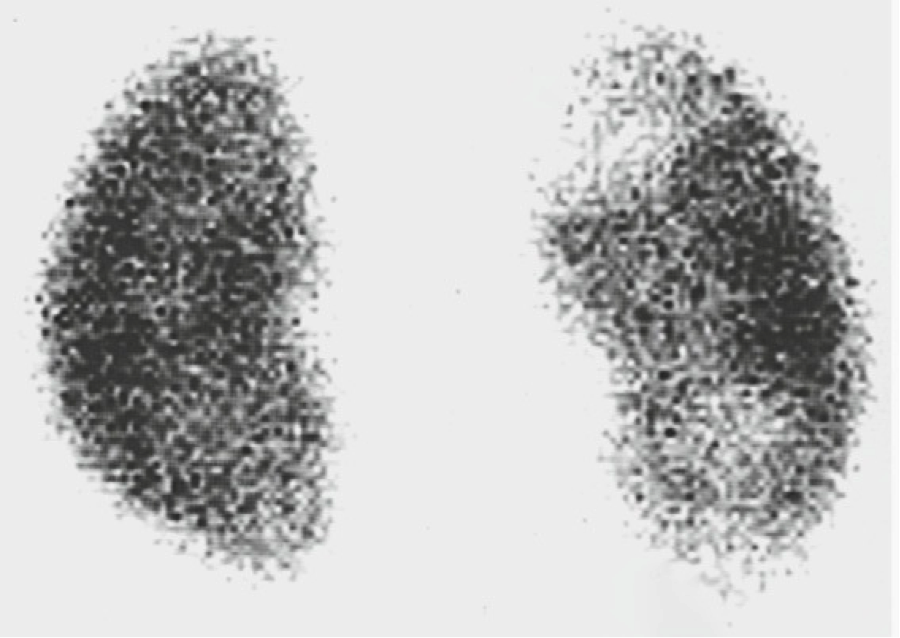
In pediatric patients in whom there is clinical difficulty in distinguishing an upper from a lower UTI, cortical scintigraphy using dimercaptosuccinic acid (DMSA) has been advocated as being the most sensitive test. In the case of pyelonephritis, this study demonstrates single or multiple areas of lack of renal uptake of the radiotracer. These areas tend to be triangular and peripheral.
In pediatric patients in whom there is clinical difficulty in distinguishing an upper from a lower UTI, cortical scintigraphy using dimercaptosuccinic acid (DMSA) has been advocated as being the most sensitive test. In the case of pyelonephritis, this study demonstrates single or multiple areas of lack of renal uptake of the radiotracer. These areas tend to be triangular and peripheral.
Renal scarring (cortical thinning)
vs
Fetal lobulation
The loss of renal cortical substance as seen by ultrasound, most commonly at one of the renal poles, is suggestive of the diagnosis.
This should not be confused with fetal lobulation (also known as an interrenicular septum, a normal variant.
In pyelonephrotic scarring, the indentations of the renal contour
tend to overlie the renal calyces, whereas in fetal lobulation, the indentations are between renal calyces.
- upper indentation: b/t calices (medullary pyramids) - fetal lobulation
- lower indentations: directly over medullary pyramids - focal scarring
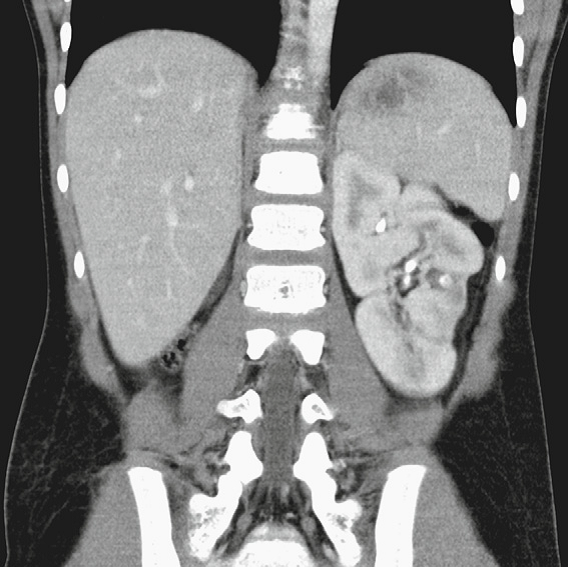
EVALUATION OF PRENATALLY
DIAGNOSED HYDRONEPHROSIS
- Consists of renal US and VCUG
- When is the best time to evaluate?
The controversy revolves around the timing of the ultrasound evaluation. In neonates, there is a relative state of dehydration
that occurs after the first 24 hours of life. Reports have shown that this relative state of dehydration can lead to underestimation or nondetection of hydronephrosis by ultrasound. Therefore, it is recommended that the postnatal evaluation of prenatally diagnosed hydronephrosis be performed during the first 24 hours of life or after 1 week of age.
Vesicoureteral Reflux Grading
Most low-grade VUR resolves sponta- neously by the age of 5 to 6 years unless there is an underlying anatomic abnormality.
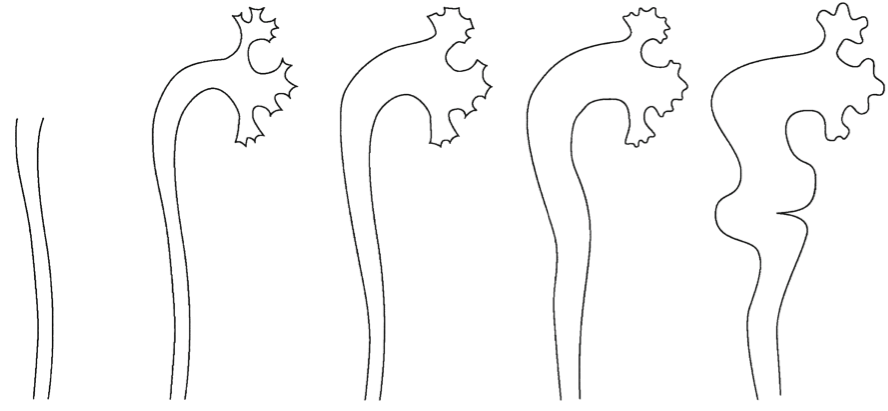
Vesicoureteral reflux grading
- Grade 1 reflux is confined to the ureter.
- Grade 2 reflux fills the ureter and collecting system (into the pelvocalyceal system), but there is no dilatation of the collecting system.
- Grade 3 reflux is associated with blunting of the calyces. In deciding whether a calyx is dilatated or not, I was taught that if it looks like you could pick your teeth with a calyx, it is not dilatated.
- Grade 4 reflux is iden- tified by progressive, tortuous dilatation of the renal collecting system.
- Grade 5 reflux is defined by the presence of a very tortuous dilatated ureter.
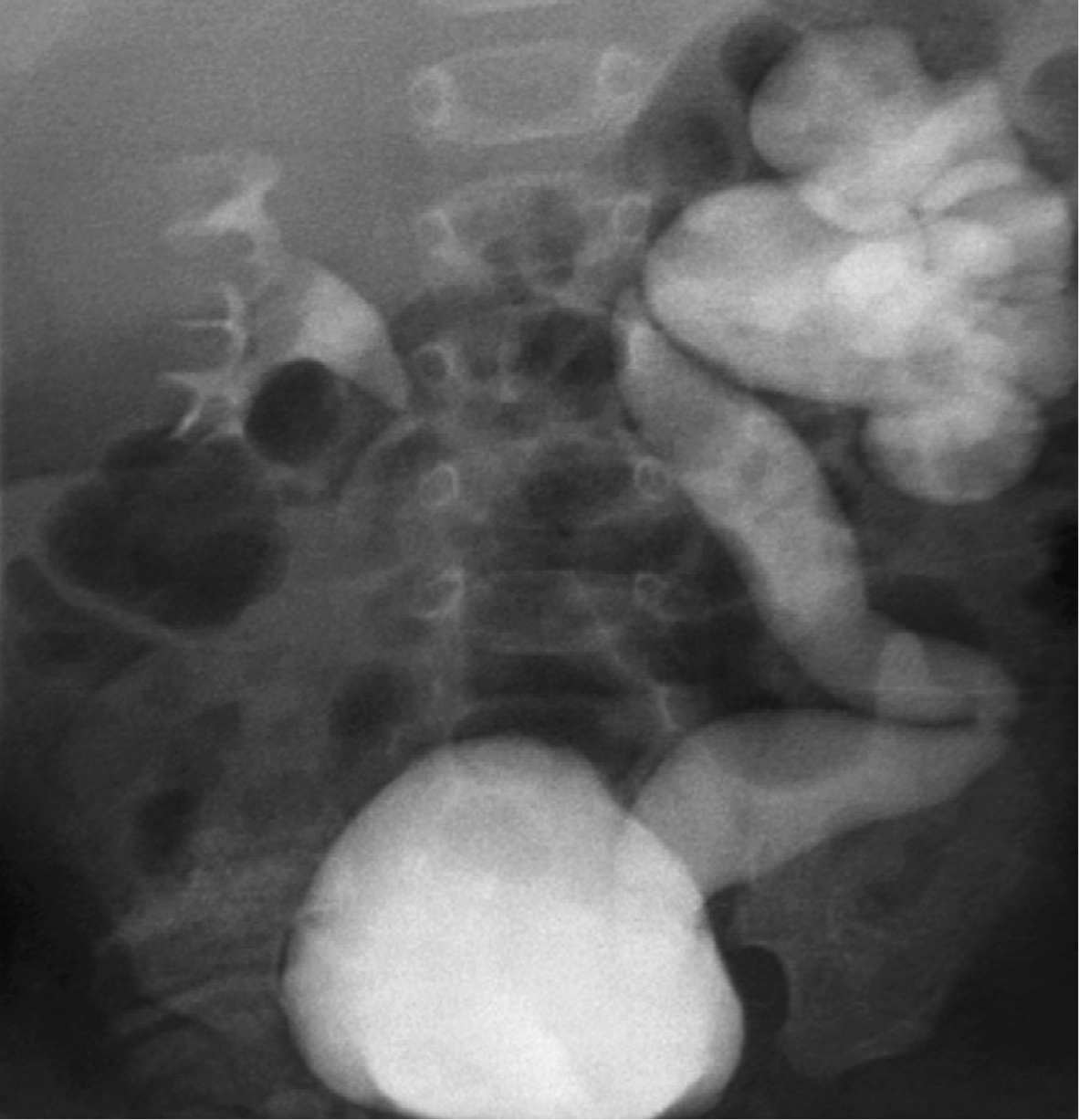
Figure example:
Right side - Grade 2
Left side - Grade 5


-
Aunt Minne and ACR100
-
Random_1100
-
Random_2100
-
Random_3100
-
Random_4101
-
Random_5100
-
Random_6100
-
Random_7100
-
Random_8100
-
Random_9100
-
Random_10100
-
Random 11100
-
Random 12100
-
Random_13100
-
Random_14100
-
Random_15100
-
Random_16100
-
Random_17100
-
Random_18100
-
Random_19100
-
Random_20101
-
Random_2129



