Why does rapid deceleration cause loss of consciousness?
The ascending reticular activating system happens to be particularly susceptible to deceleration trauma, and it is the main circuit responsible for wakefulness
Acute management of concussion (in the field)
Remove the individual from physical activity until they are further evaluated by a medical professional (often at the ED)
A standardized concussion symptom checklist (of which many reliable tools are available online, such as the ImPACT) may be utilized. These scores taken at various time intervals help track the progression in the acute setting.
Indications for urgent evaluation in the ER following suspected TBI
- New or worsening neurologic signs
- Focal deficits
- Potential spinal injury
- GCS of anything less than 15
Managing second concussions
Management of concussions is generally on the conservative side, and for second concussions it should be even more conservative.
Recurrent concussions are associated with prolonged recovery time and more severe symptoms with loss of consciousness than first time concussion.
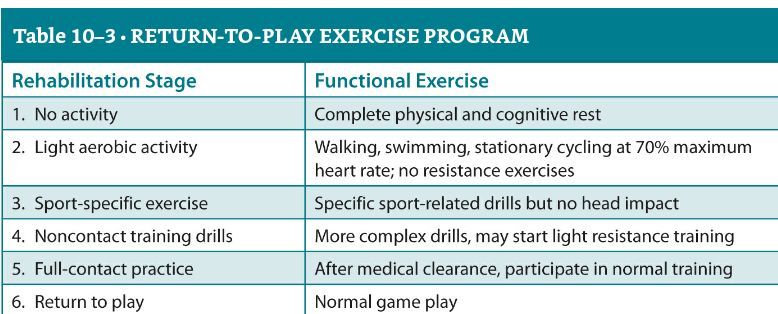
Rate of incremental return to activities following concussion
Increments should be between 1 to 5 days depending upon the individual’s injury and rate of recovery.
If symptoms recur, the athlete should rest for 24 hours, then resume activity at the last stage that was tolerated.
Second impact syndrome
- Rare, life-threatening syndrome of cerebral vacsular congestion and diffuse cerebral edema that occurs when an athlete sustains a second concussion while recovering from a primary concussion
- Pediatric and adolescent patients are at the highest risk for this condition
Postconcussion syndrome
- Constellation of symptoms observed following a concussion. Quickly resolve in most, but may persist for weeks to years in some.
- Symptoms include:
- Headache
- Dizziness
- Poor concentration
- Insomnia
- Irritability
- Considered chronic if symptoms last for > 1 year
- Higher risk with repeat concussions
Chronic traumatic encephalopathy
Syndrome of progressive cognitive decline and behavior change seen years later in athletes who have sustained multiple head injuries
Includes neurocognitive impairment as well as motor symptoms (tremor, ataxia, hypertonia)
Autopsy shows diffuse brain atrophy and tau deposition.
Who gets a CT scan in the setting of a suspected concussion?
- Loss of consciousness
- Altered or worsening mental status
- Anisocoria
- Seizure
- Focal defecits
- Repeated emesis
- Age older than 60

-
Stroke69
-
Back to Basics2
-
Essential Tremor13
-
Huntington's Disease19
-
Encephalitis in a Healthy Individual18
-
Parkinson's Disease27
-
Hereditary Neurodegenerative Ataxias17
-
Tardive Dyskinesia and Related Dyskinesias11
-
Acute Spinal Cord Injury15
-
Epidural/Subdural Hematoma6
-
Delirium6
-
Concussions9
-
Lumbar Puncture4
-
Cerebral Cortex I and Vascular Territories49
-
Stroke and Intracerebral Hemorrhage46
-
Seizure and Epilepsy118
-
Subarachnoid Hemorrhage16
-
Stroke in a Young Patient12
-
Peripheral Neuropathy46
-
Syncope and Loss of Consciousness of Unknown Etiology13
-
Psychogenic Nonepileptic Spells7
-
Multiple Sclerosis and Other Myelopathies45
-
Headache55
-
Neuro Exam and Basic Neuro Tips13
-
Approach to Ataxia and Gait Disorders9
-
Alzheimer's Dementia22
-
Lewy Body Dementia18
-
Subacute Combined Degeneration of the Spinal Cord14
-
Optic Neuritis22
-
Acute Disseminated Encephalomyelitis13
-
Meningitis28
-
Botulism19
-
HIV-associated Neurologic Dysfunction/Dementia11
-
Creutzfeld-Jakob Disease18
-
Neurosyphilis24
-
Toxoplasmosis12
-
Sleep Disorders22
-
Pupillary Responses22
-
Pseudotumor cerebri14
-
Diplopia and Oculomotor Palsies8
-
Zoster13
-
Myasthenia20
-
Vertigo12
-
Chronic inflammatory demyelinating polyneuropathy7
-
Guillain-Barre Syndrome17
-
Uncovered High-Yield Topics39
-
Neuro Oncology33
-
Myositides25
-
Amyotrophic Lateral Sclerosis13
-
Anterior Horn Cell Diseases15
-
Febrile Seizure12
-
Muscular dystrophies8
-
Tics and Tourette Syndrome19
-
Benign Rolandic Epilepsy7
-
Lissencephaly13
-
Autism Spectrum Disorder9
-
Cerebellopontine Angle Mass15
-
Wilson's disease4
-
Last Week Prep39
-
Ned Divine Review23



